
Commission & Salgspuls
Your reps already know what they have earned
Commission stops being a monthly argument when every seller can read their own pay. CloudDialer ties payouts to the order lifecycle, and shows each rep what is paid, what is on the way, and what is still a draft — live, in their own currency.
The Salgspuls dashboard
One screen that answers "what have I earned?"
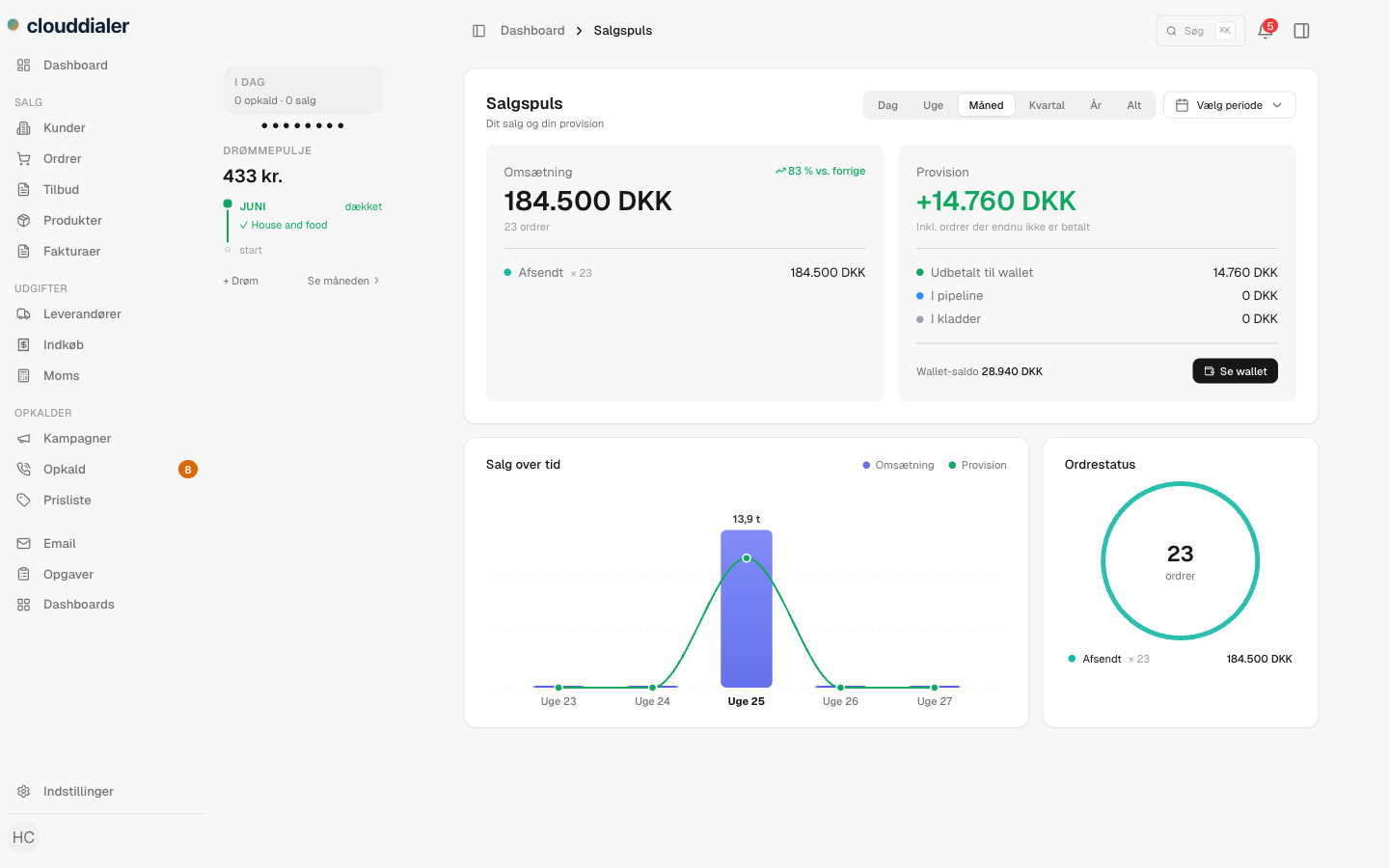
Every rep gets a personal Salgspuls. It splits their commission into three honest buckets and the three add up to the total — no rounding into a number nobody can explain. They pick a period, from a single day to a full year, and the chart and the buckets move with it.
- Udbetalt — already credited to their wallet, money they can count on.
- I pipeline — sold orders that will pay out once the order reaches its trigger.
- I kladder — draft orders, the earnings still being built.
- Pace against the same length of time just before, so a rep knows if this month is ahead or behind.
Tied to the deal, not to a guess
Commission follows the order, stage by stage
Accepted
Pay the moment a customer says yes — good for teams that reward closing the deal up front.
Completed
Pay when the order is fulfilled and shipped, so commission lands with delivery rather than the handshake.
Paid
Pay only when the customer's money is actually in — the conservative choice, and the one a manual override always uses.
Built on the Rules engine
Write the plan your team actually runs on
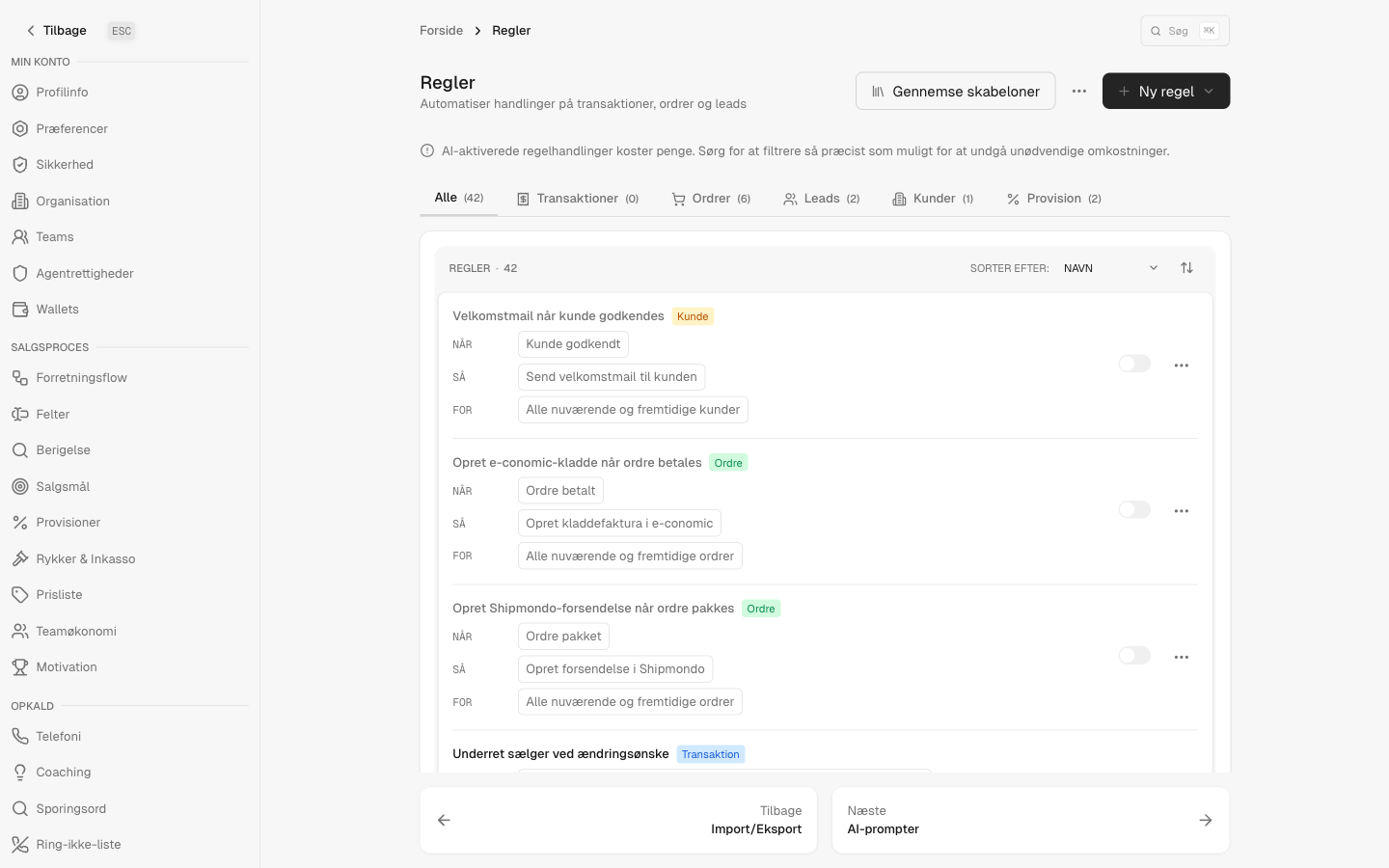
Commission is a module that plugs into the same Rules engine the rest of CloudDialer uses, so the plan bends to how you sell instead of the other way around. Set a flat percent, a fixed amount, or a conditional formula; scope it to all products, a category, or named SKUs; aim it at the whole team or specific reps; and reward variety with diversity bonus tiers that pay more when an order spans more products.
- Conditions per rule — order total over a threshold, a minimum number of unique products, a customer group, whether the order carries a gift.
- Priority and exclusivity so two rules never quietly double-pay the same trigger.
- Aim a rule at the whole team or a named list of reps.
Why it holds up at payout time
Numbers a rep and a manager can both trust
Frozen at credit
When a commission is credited, the rule name, the formula, and the order totals are snapshotted onto the entry. Change a rule next quarter and last quarter's payouts stay exactly as they were paid.
Their pay, not a black box
The rep sees the same projection the engine will credit — pipeline and paid line up because they are the same math, run once and read everywhere.
In their own currency
Every amount is converted to the rep's wallet currency at the order's locked exchange date, so a seller working across the Nordics reads one consistent number.
One override when you need it
An optional, admin-only per-order override replaces the rule result for a single deal, pays out once on paid, and never stacks on top of a rule that already paid.
Questions managers ask
Can each rep be on a different plan?
Yes. A rule can target the whole team or a specific list of reps, and you can run several rules side by side. Reps only ever see their own Salgspuls.
What stops two rules from paying twice for the same sale?
Rules are ordered by priority, and a rule can be marked exclusive so it stops processing once it pays for a trigger. The engine also blocks a duplicate entry for the same order and rule.
If I edit a rule, does it rewrite past payouts?
No. Each credited commission freezes the rule name, formula, and order figures onto its own entry. Edits apply going forward; history stays as it was paid.
Is the manual override on by default?
No. The per-order override is an optional add-on you switch on per organization. When it is off, every payout comes from the rules. When it is on, an override pays once, on the paid trigger, and never doubles up with a rule.
Pay your sellers a number they can read
Turn on the commission module, write the plan your team runs on, and give every rep a Salgspuls they can check whenever they want. No spreadsheet, no month-end surprise.